
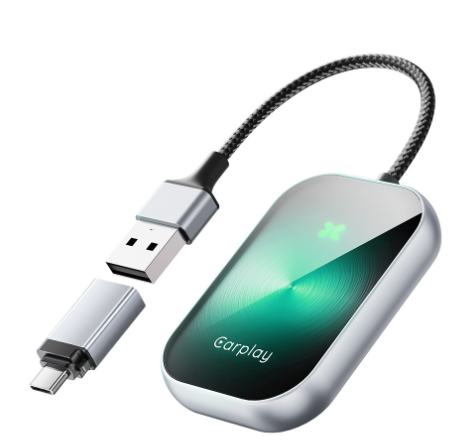
The concept of wireless CarPlay relates to the wireless connection technology between the vehicle system and the smartphone. From what I can see from my research, CarPlay was originally connected to a smartphone via cable, such as USB or Bluetooth. However, with the development of technology and the increase of user demand, wireless CarPlay has become an important research and development direction.
The evidence suggests that although CarPlay initially relied primarily on wired connections, a number of wireless solutions are already on the market. SAIC’s Android version of CarPlay, for example, supports third-party applications, suggesting the possibility of wireless data transmission to some extent. In addition, with the release of ios 12, Apple also began to support third-party navigation applications, which further boosted the wireless CarPlay function.
Despite these developments, however, wireless CarPlay still faces some challenges. For example, the mobile-locomotive interconnection scheme mentioned in the search results has the problems of incompatibility and high synchronization delay. This shows that although wireless CarPlay has made some progress in technology, it still needs to solve some key problems in practical applications to improve the user experience.
Wireless CarPlay is a growing field that combines the advantages of in-car systems and smartphones to provide a more convenient and secure driving experience. In the future, with the continuous progress of technology and increasing market demand, wireless CarPlay is expected to achieve a wider range of applications and better performance.
How to solve the problem of compatibility and synchronization delay in wireless CarPlay?
To solve the compatibility and synchronization delay problems in wireless CarPlay, the following strategies can be used:
Optimize data synchronization strategy: according to, can use the probability model to express the data structure evolution, and simulate the user behavior, thus formulate can minimize the synchronization time of the objective function. This approach can help us manage and synchronize the data in CarPlay more effectively, reducing the delay caused by improper synchronization.
We can apply the similar technique to the wireless CarPlay system to reduce the transmission delay of the communication between the nodes. This involves implementing a weighted averaging algorithm on each device to optimize the exchange and update of clock information to improve synchronization accuracy.
Improving the compatibility of Bluetooth access: according to this, the compatibility problem of Bluetooth access can be solved by implementing Mac and QoS-supported differential scheduling algorithm. This will help to establish effective communication links between master and slave nodes to ensure the quality and efficiency of data transmission.
Use modern techniques for fault location: the TCSA technique mentioned in the reference can be used to locate performance errors in busy waiting synchronization. While this is primarily used by cloud service providers, the same principles can be applied to wireless CarPlay systems to identify and resolve thread contention and function call stack issues that can cause latency or compatibility problems.
What are the security challenges for wireless CarPlay and how can they be overcome?
The security challenges facing wireless CarPlay include the following:
Wireless CarPlay relies on a variety of communication protocols (such as LIN, CAN, FlexRay, etc.) to communicate within the vehicle and with the peripheral equipment. These protocols can be targeted by attackers because of design flaws or implementation errors.
Security risk of external access points: when connected to the vehicle network by wireless technology, external attackers can use these access points for network intrusion. This includes functions such as remote diagnostics, firmware updates, and so on, which can be exploited for malicious purposes.
Management of complex electronic control units (ecus) : modern cars consist of more than 100 ecus responsible for all aspects of the vehicle, from Système d’aide à la conduite, à l’exploitation et à la maintenance to safety-critical systems. The complexity and interoperability of these systems increase the potential for security threats.
Data breaches and privacy issues: as vehicles become”Smarter,” they collect and store more and more personal and sensitive information. If this information is not properly protected, it may be accessed or stolen by unauthorized persons.
The following measures can be taken to overcome these challenges:
Strengthen the security of communication protocols: develop and implement more secure communication protocols, and reinforce the existing protocols to reduce the security risks caused by protocol flaws.
Implement defense-in-depth strategy: adopt a layered defense approach to gradually enhance security measures from the physical layer to the application layer. This includes the use of encryption to protect data transmission, the deployment of intrusion detection systems and firewalls, and regular security audits and vulnerability scanning.
Improve the system’s ability to resist attacks: through simulation of various scenarios to test and improve the system’s resistance. This not only helps identify potential security vulnerabilities, but also validates the effectiveness of the security measures taken.
Education and training: Conduct Safety Awareness Training for vehicle manufacturers, software developers and end users to ensure that they are aware of possible security risks and know how to take precautions when using wireless CarPlay.
What are the trends in user acceptance and demand for wireless CarPlay?
Users of wireless CarPlay acceptance and demand trends can be analyzed from multiple angles. First, according to the technology acceptance model (Tam) and the unified theory (Utaut) , users’ acceptance of new technologies is usually influenced by their perceived usefulness and perceived ease of use. In the case of wireless CarPlay, users may be more inclined to embrace the technology if they think it will improve their driving experience or bring other practical benefits.
In addition, social influence is also an important factor. According to TAM2 model, social influence includes subjective norm, willingness and image, which can significantly influence the acceptance behavior of users. For example, if a friend or colleague has started using wireless CarPlay and shared a positive experience, this may prompt more people to try and embrace the technology.
Price values and habits are also key factors that affect user acceptance. According to the UTAUT2 model, these factors adjust for individual differences (such as age, sex, and experience) in behavioral intentions and technology use. Younger users may be more receptive to new technologies, while price-sensitive users may need more cost–benefit analysis to drive adoption.
From the application of automotive industry, Bluetooth technology has been widely used in the automobile, such as hands-free communication, car entertainment system. This indicates that the market has some infrastructure and user habits to support the further development and popularity of wireless CarPlay.
In summary, user acceptance and demand trends for wireless CarPlay are influenced by a number of factors, including perceived usefulness of the technology, perceived ease of use, social impact, price value, and user habits.